




Kombucha as a DIY beauty ingredient
Many people know kombucha primarily as a fermented tea drink. Fermented ingredients and bacterial cellulose are also used in cosmetics as special raw materials. Online, you can also find DIY ideas using kombucha or a SCOBY for the face, body, and hair. The important thing is: a self-fermented drink is not a standardized cosmetic raw material. Acidity, composition, and microbial contamination can vary. We’ll show you what ideas are out there and what you should pay attention to when it comes to skincare.

Face mask – DIY care with kombucha
Online, mixtures of SCOBY, kombucha, and coconut oil are presented as DIY face masks. However, caution is advised when using them on the face: self-fermented kombucha and a SCOBY are not standardized for cosmetic use. The acidity and the microorganisms contained within can vary. There is no evidence that this combination of ingredients provides a nourishing skin feel or any specific cosmetic effect.
The ingredients of the popular DIY recipe idea:
- 100 g SCOBY
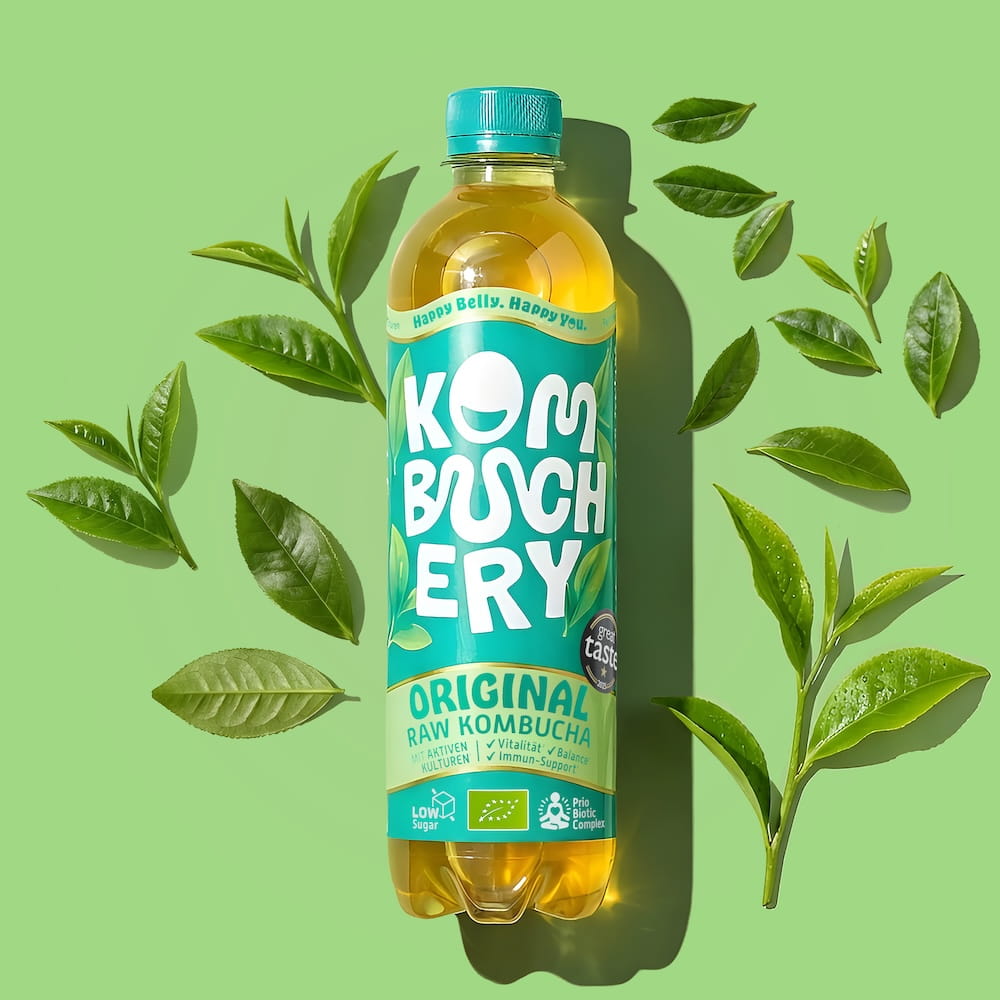
- 15 ml Kombucha Original
- 15 ml coconut oil
What should you pay attention to?
We do not recommend processing self-fermented kombucha or a SCOBY into a face mask or applying it to the skin. The mixture has not been tested for microbiological stability or skin compatibility. Avoiding the eye area does not automatically make such an application safe.
If you want to care for your skin, it is better to use a cosmetic product that has been developed for use on the face. You should use new skincare products according to their instructions and discontinue use immediately if you experience burning, redness, or itching.

DIY body care with kombucha
After a day in the sun, your skin may feel dry and stressed. Suitable body care can help keep the skin supple. In DIY recipes, jojoba oil and kombucha are combined, among other ingredients. However, water or watery drinks and oil cannot be permanently mixed into a homogeneous mixture. Without proper formulation and preservation, such a mixture can also be microbiologically unstable.
The ingredients of the popular DIY recipe idea:
- 50 ml jojoba oil
- 2 tablespoons Kombucha Original
Important application note:
We do not recommend applying kombucha and jojoba oil to the skin as a homemade lotion. The ingredients separate, and the mixture does not have a tested preservation system. For dry skin, a product specially developed for this purpose or a suitable, fragrance-free body oil is a more reliable choice.
Tip:
Mixtures of kombucha, yogurt, quark, SCOBY, and olive oil are also described as DIY care ideas. However, food mixtures are not specially formulated or preserved for the skin and can differ in their compatibility. Therefore, do not use such mixtures as a substitute for tested cosmetic products—especially not on irritated, injured, or sunburned skin.

Kombucha – Foot bath
A warm foot bath can be a relaxing addition to your care routine. In DIY recipes, very acidic kombucha or kombucha vinegar, mineral salt, and essential oils are sometimes used. However, because the acidity and composition of self-fermented products can vary, this combination cannot be reliably assessed for skincare.
The ingredients of the popular DIY recipe idea:
- 250 ml very acidic kombucha or alternatively 150 ml kombucha vinegar
- 1 cup Epsom salt or alternatively another suitable bath salt
- Eucalyptus oil or another essential oil
A simple alternative:
Warm water is sufficient for an uncomplicated foot bath. If you want to use a bath additive, choose a product expressly intended for this purpose and follow the application instructions. Avoid acidic mixtures and essential oils on irritated or injured skin. If you have open wounds or known skin problems, you should avoid such DIY applications.
Kombucha – Hair conditioner
Some DIY guides recommend diluted kombucha as a hair conditioner. Because the acidity and composition vary depending on the fermentation, its effect on the hair and scalp cannot be reliably predicted. An acidic liquid can cause irritation on sensitive scalps and should not come into contact with the eyes.
The ingredients of the popular DIY recipe idea:
- 100 ml unpasteurized kombucha
- 100 ml water
What should you pay attention to?
We do not recommend using self-fermented kombucha as a hair conditioner. If you want to try a conditioner, use a hair care product developed for this purpose and follow the application instructions. For sensitive scalps, mild products suitable for your hair type are usually the better choice.
Enjoy your care routine—and remember that DIY does not automatically mean skin-compatible.
Frequently asked questions about kombucha in skincare and hair care
Can kombucha be applied to the skin?
Self-fermented kombucha is not a standardized cosmetic raw material. Its acidity and microbial composition can vary. Therefore, we do not recommend applying it undiluted or as an ingredient in homemade face masks and lotions to the skin.
Is a SCOBY suitable for a face mask?
A SCOBY consists mainly of bacterial cellulose and houses microorganisms from the kombucha culture. However, it has not automatically been tested for cosmetic use. For this reason, a homemade SCOBY face mask is not equivalent to a tested cosmetic product.
Can kombucha be used as a hair conditioner?
There is no general application recommendation for self-fermented kombucha as a hair conditioner. The acidity can vary and irritate sensitive scalps. It is better to use a conditioner developed for hair and scalps.
What should you consider with homemade cosmetics?
Homemade mixtures with water, tea, or food can be microbiologically unstable. Natural ingredients can also cause skin irritation or allergic reactions. For the face and body, cosmetic products with a suitable formulation and safety assessment are the more reliable choice.






Share: